Evolve Brain Training: Boost Your Brain | Brain Training Dubai

Non-Invasive Treatment for Insomnia

1,200+

Happy Clients

6+ years

of results

4.8 STARS

on Google

No-Medication Insomnia Treatment in Dubai

The lack of good, restorative sleep can give rise to a host of physical, emotional and mental problems like weight gain, anxiety and loss of memory and focus. The quality of your sleep is also associated with your brain’s ability to protect itself from neurodegenerative diseases like Alzheimer’s as you grow older. 

When you miss sleep, you miss out on the vital processes that happen only when you are in a state of deep rest: The body restoring itself during the first half of your sleep cycle, and your brain repairing itself during the second half. If you are having difficulties with sleep, exploring our non-invasive, science-based insomnia and sleep apnea treatment in Dubai can help. 

Did You Know?

0 %
Of people suffer from some form of sleep disorder.
0 %
Of the UAE population experiences insomnia.
0 %
Of people in the UAE have sleep disorder related to sleep apnea.

Common Symptoms

How Does Brain Training Help People With Sleep Disorders?

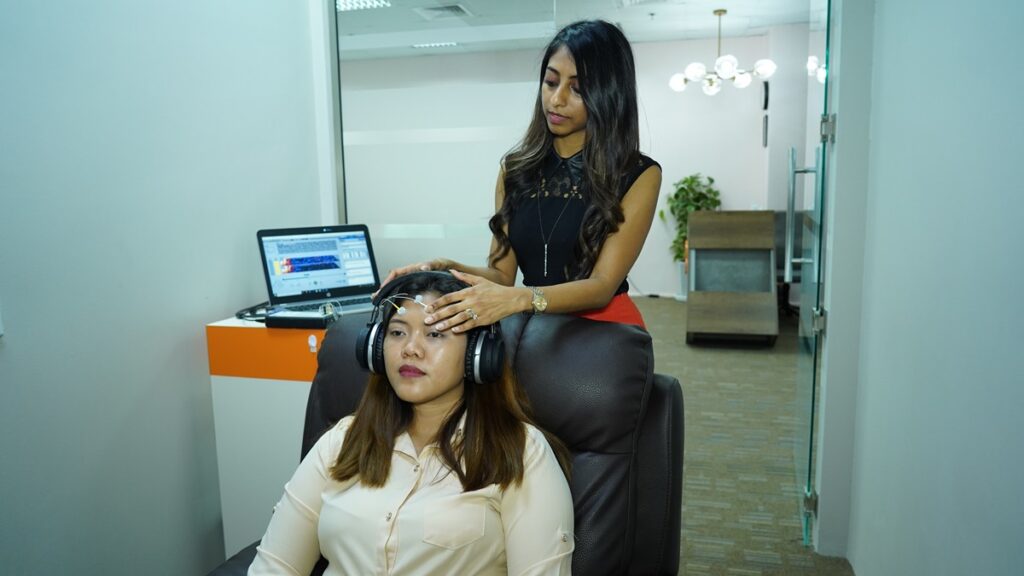
A key ingredient to overall well-being is good quality sleep. Insomnia, sleep apnea and other sleeping disorders can make bedtime difficult, but the good news is that we now have the ability to train our brain to sleep well. At Evolve Brain Training, we use EEG sensors to read your brainwave activity and provide your brain with feedback in real time. We’ll ask you to sit on a comfortable couch where we provide your brain with audio-visual cues. Your brain impulses fluctuate based on how you perceive these cues. A positive reward, in the form of an enlarged video screen and louder audio, is delivered every time your brain follows a positive behavior.

Over time, this positive reward turns into habitual behavior, a key element of insomnia treatment, forcing your brain to regulate itself towards staying calm and relaxed to achieve improved sleep quality. By the end of your customized brain training program, you will have a good night’s sleep every night, wake up fresh and feel energetic throughout the day.

It only takes a few sessions to get a good night's sleep every night. Commit to our neurofeedback program in Dubai for insomnia and take the brave step towards reclaiming your much-needed rest. Fill the form below to schedule a free 15-minute consultation with Evolve Brain Training.

Testimonials

This was a wonderful and most interesting experience to see how my brain can be influenced to function progressively better with each session and that anxiety can be managed effectively this way. Dr Upasana is great and very knowledgeable and her staff is so supportive and friendly all the time. Thank you team for your continuous help! See you soon.

Anoesjka Myburg

Midwife

I had alot of problems with sleep. Every night, i would maybe get only a couple hours of sleep and would get awakened with the tiniest of disturbances. Evolve has honestly made my life so much better. Not only can I sleep, but I have also managed to lose weight which I wasn’t able to do before. My ability to handle my stress and anxiety is also much better. I recommend Evolve to anyone who is serious about making a positive change in their life.
Atheeqe Ansari
How It Works

Initial consultation

We will discuss your specific needs and goals during consultation.

Neuropsychosocial assessment

We will do an in-depth assessment to understand your brain’s current strengths and weaknesses

Personalized training plan

Get a customized plan tailored to your specific needs.
Neurofeedback training

We begin your neurofeedback training sessions to help sharpen your brain.

Final assessment

We will repeat the neuropsychosocial assessment to track your progress.

Book Your Free 15-Minute Consultation

Let us help you make mental health a priority. Get a free, no-strings attached session to get started.

  • This field is for validation purposes and should be left unchanged.

Learn More About Neurofeedback

Sitaram R. et al. (2017).

Closed-loop brain training: the science of neurofeedback.Nature Reviews Neuroscience, 18, 86–100.
Read More

Wigton N. & Krigbaum G. (2015).

A Review of qEEG-Guided Neurofeedback. NeuroRegulation, 2(3), 149-155.
Read More

Ros T. et al. (2014).

Tuning pathological brain oscillations with neurofeedback: A systems neuroscience framework. Frontiers in Human Neuroscience, 8(December), Article 1008.
Read More

Ghaziri J. et al. (2013).

Neurofeedback training induces changes in white and gray matter. Clinical EEG and Neuroscience, 44(August 2016), 265–72.
Read More

Coenan A. et al. (2009).

Efficiency of Neurofeedback Treatment in ADHD: the Effects on inattention, Impulsivity and Hyperactivity: a Meta-Analysis.Journal of Clinical EEG & Neuroscience, 40(3), 180-189.
Read More

Yue Hou,Shuqin Zhang,Ning Li,Zhaoyang Huang,Li Wang,Yuping Wang (2021).

Neurofeedback training improves anxiety trait and depressive symptom in GAD. Brain and Behavior. 11. 10.1002/brb3.2024.
Read More

Dreis, Stephanie & Gouger, Angela & Perez, Edward & Russo, G. & Fitzsimmons, Michael & Jones, Mark. (2015).

Using Neurofeedback to Lower Anxiety Symptoms Using Individualized qEEG Protocols: A Pilot Study. NeuroRegulation. 2. 137-148. 10.15540/nr.2.3.137.
Read More

Kerson, C., Sherman, R. A., & Kozlowski, G. P. (2009).

Alpha suppression and symmetry training for generalized anxiety symptoms. Journal of Neurotherapy, 13(3), 146–155.
Read More

Hammond, D.. (2005).

Neurofeedback Treatment of Depression and Anxiety. Journal of Adult Development. 12. 131-137. 10.1007/s10804-005-7029-5.
Read More

Hammond, D.. (2005).

Neurofeedback with anxiety and affective disorders, Child and Adolescent Psychiatric Clinics of North America, Volume 14, Issue 1, 2005, Pages 105-123.
Read More

Thomas, J.E., & Sattlberger, E. (2007).

Treatment of Chronic Anxiety Disorder with Neurotherapy: A Case Study. Journal of Neurotherapy, 2(2).
Read More

Kosari Z, Dadashi M, Maghbouli M, Mostafavi H.(2019).

Comparing the Effectiveness of Neurofeedback and Transcranial Direct Current Stimulation on Sleep Quality of Patients With Migraine. Basic Clin Neurosci. 2019 Nov-Dec;10(6):579-588. doi: 10.32598/BCN.10.6.651.3. Epub 2019 Nov 1. PMID: 32477475; PMCID: PMC7253802.
Read More

Dobrushina, O., Arina, G., Osina, E., & Aziatskaya, G. (2017).

Clinical and Psychological Confirmation of Stabilizing Effect of Neurofeedback in Migraine. European Psychiatry, 41(S1), S253-S253. doi:10.1016/j.eurpsy.2017.02.045
Read More

Walker JE. (2011).

QEEG-guided neurofeedback for recurrent migraine headaches. Clin EEG Neurosci. 2011 Jan;42(1):59-61. doi: 10.1177/155005941104200112. PMID: 21309444.
Read More

Perez-Elvira, Ruben & Carrobles, José & Bote, Diego & Oltra-Cucarella, Javier. (2019).

Efficacy of Live Z-Score Neurofeedback Training for Chronic Insomnia: A Single-Case Study. NeuroRegulation. 6. 93-101. 10.15540/nr.6.2.93.
Read More

Kosari Z, Dadashi M, Maghbouli M, Mostafavi H. (2019).

Comparing the Effectiveness of Neurofeedback and Transcranial Direct Current Stimulation on Sleep Quality of Patients With Migraine. Basic Clinical Neuroscience. 2019;10(6):579-588.
Read More

Frequently Asked Questions

Neurofeedback is fast-becoming the preferred non-medicated insomnia treatment option with long-lasting effects. Research and evidence-based practice has demonstrated that neurofeedback can decrease the time it takes to fall asleep, increase sleep spindle density (Arns M, Feddema I, Kenemans JL., 2014) and increase total sleep time, and that training the brain using neurofeedback results in long-term improvement in sleep quality.

You can find our complete price list here – Price List

Here at Evolve Brain Training we do not process insurance claims. We can provide a statement for you to submit to your insurance company.

Since neurofeedback involves learning and every person is unique, the type, order and pace of change differs from person to person. You will start experiencing benefits within the first few sessions. But for these effects to last, we recommend a full package of 20 sessions. However, some may require more than 20 sessions.

Common causes of insomnia include:

  • Poor sleeping habits
  • Stress
  • Mental health disorders
  • Physical illnesses and pain
  • Neurological problems


The combination of any of these factors can trigger or worsen insomnia for many people.

Neurofeedback is an increasingly well-supported option for those who prefer a non-talking, non-medication approach. By using EEG sensors to read and retrain brainwave activity in real time, neurofeedback helps the brain build calmer, self-regulating patterns.

Behavioral and psychological interventions, including cognitive behavioral therapy (CBT), are effective for both primary insomnia and insomnia that co-occurs with other conditions, and encourage these as the first line of treatment. The specialist may also recommend medication, particularly sleeping pills.

Yes. Depression and insomnia often occur together. When someone has one, the chances of developing the other increase. 

Sleep problems have long been viewed as a symptom of depression. However, newer long-term studies suggest that insomnia can also play a separate role. Research shows that ongoing sleep difficulties may increase the risk of developing depression or experiencing it again, and this pattern appears across people of all ages.

Yes, insomnia is a serious condition that can have significant consequences for physical and mental health when left unaddressed. Chronic sleep deprivation is associated with weakened immunity, weight gain, impaired memory and concentration, heightened anxiety, and an increased risk of cardiovascular disease and neurodegenerative conditions such as Alzheimer’s. 

The brain carries out critical repair and restoration processes during sleep, and persistent insomnia disrupts these functions. Seeking treatment early is important for protecting long-term well-being.

No, insomnia and sleep apnea are distinct conditions, though they can occur together. Insomnia is characterized by difficulty falling asleep, staying asleep, or waking too early — primarily a problem of the brain’s ability to regulate its sleep-wake cycle. Sleep apnea is a physical condition in which breathing repeatedly stops and starts during sleep, often causing loud snoring and fragmented rest. Both can result in daytime fatigue and poor sleep quality, but they require different assessment and treatment approaches.

Research suggests that insomnia does have a genetic component, meaning it can run in families. Studies have identified gene variants associated with sleep regulation and susceptibility to insomnia, particularly in relation to how the brain manages stress responses and circadian rhythms. However, genetics is only one factor; lifestyle, environment, anxiety, and learned sleep habits also play a significant role. This means that even individuals with a genetic predisposition can often improve their sleep quality with the right intervention.

The brain can be trained to sleep better through consistent behavioral habits and targeted brain training approaches. Keeping a regular sleep and wake time, avoiding stimulating activities close to bedtime, and creating a calm sleep environment all help reinforce healthy sleep signals. 

Neurofeedback therapy takes this further by directly training the brain’s electrical activity. For sleep disorders, this process rewards the brain in real time to produce the relaxed brainwave states associated with restful sleep. Over a course of sessions at Evolve Brain Training, many people find they fall asleep more easily and wake feeling genuinely rested.

Good sleep hygiene involves a set of consistent habits that signal to the brain that it is time to wind down. Key practices include going to bed and waking at the same time each day, avoiding screens and bright light for at least an hour before bed, limiting caffeine after midday, keeping the bedroom cool and dark, and managing stress through relaxation techniques. When sleep hygiene alone is not sufficient — particularly if anxiety or overactive brain activity is the underlying issue — neurofeedback therapy can help address the neurological patterns disrupting sleep.

The time it takes to resolve insomnia depends on how long it has been present and what is driving it. Short-term insomnia triggered by a specific stressor can improve within days or weeks once that stressor is addressed. Chronic insomnia typically takes longer and often runs several weeks to months with consistent treatment. With neurofeedback therapy, many people at Evolve Brain Training begin to notice improvements in sleep quality within their first few sessions, with more sustained and lasting results building across a full program.

For many people, insomnia can be fully resolved, particularly when it is addressed with a comprehensive approach that targets its root cause. Short-term insomnia often clears once underlying stressors are removed. Chronic insomnia responds well to evidence-based treatments such as cognitive behavioral coaching for insomnia and neurofeedback therapy, which retrains the brain’s sleep regulation at a neurological level. While some individuals may require ongoing management, many achieve lasting improvement in sleep quality without the need for medication.

Get answers to your most urgent neurofeedback questions.
Start with a free first consultation.

Technology Used By

Related Blogs