Evolve Brain Training: Boost Your Brain | Brain Training Dubai

Improve Memory with Neurofeedback

1,200+

Happy Clients

6+ years

of results

4.8 STARS

on Google

Neurofeedback for Memory Improvement

We make numerous memories each day but some memories stay with us for a long time while others don’t seem to stick around. It is because our brains have to assess what memories it has to preserve and what it can do away with. When we are asleep, our brain sorts through all of the memories it made during the day and strengthens the ones that it thinks is important in a process called memory consolidation. This ability of our brains seems to naturally decline with age and other causes. However, you don’t have to accept it as it is. Know more about how neurofeedback for memory training can improve memory recall and enhance information retention.

Did You Know?

0 %
Of the total population is shown to have probable Alzheimer's Disease symptoms
0 %
Of people between 65-74 years old with Alzheimer's Disease symptoms

Common Symptoms

How to Improve Your Memory With Brain Training

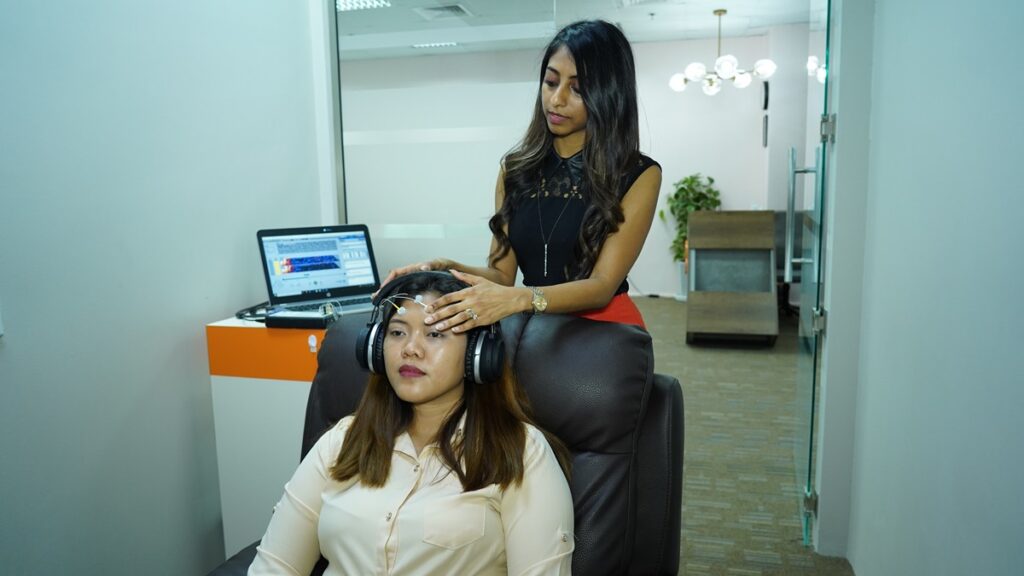
Forgetfulness is a normal part of aging, but we can now train our brain to improve memory and concentration so our brains can stay young even as we age. In your neurofeedback session, all you have to do is watch any audio-visual material of your choice while being seated on a relaxing couch. While you’re enjoying your show, your brain activity is being read by the EEG sensors that we attach to specific points on your scalp. These non-invasive sensors allow you to gain feedback from your brain in real time. Whenever your brain promotes healthy activity, you will be rewarded in the form of better audio and video quality. After a few sessions, this newly learnt healthy brain activity becomes a habit, and you will naturally be able to pay attention and remember better. By the end of your customized brain training program, you will see drastic improvements in your memory, mental clarity and focus.

Don't let brain fog and forgetfulness affect your quality of life. Let us create a neurofeedback training regimen that will help keep the brain sharp and active in the years to come. All you have to do is request a free 15-minute consultation at our clinic in Dubai to begin your journey with us.

Testimonials

The best investment I made in 2020 was to go for this brain training. I used to be less motivated, very distracted with my thoughtsand less eficient. After my sessions here, my life has changed 180 degrees to the better where it helped me reach my peak performance, banish depression, control my emotions and be the best version of myself. I even speak up in meetings more in ways I never did before. Highly highly recommended!

Rawan AlHussein

I first heard about Evolve through my trainer and I thought of giving it a try because I was having issues with anxiety, procrastination and was even struggling to focus and concentrate on my career. After 20 sessions of brain training, I have to say that I feel like a completely new person. I don’t procrastinate any longer, I am more confident, I can see a reduction in my anxiety and I’m able to focus better on my career. I feel that the world just opened for me.

Lucia Sharpe
How It Works

Initial consultation

We will discuss your specific needs and goals during consultation.

Neuropsychosocial assessment

We will do an in-depth assessment to understand your brain’s current strengths and weaknesses

Personalized training plan

Get a customized plan tailored to your specific needs.

Neurofeedback training

We begin your neurofeedback training sessions to help sharpen your brain.

Final assessment

We will repeat the neuropsychosocial assessment to track your progress.

Book Your Free 15-Minute Consultation

Let us help you make mental health a priority. Get a free, no-strings attached session to get started.

  • This field is for validation purposes and should be left unchanged.

Learn More About Neurofeedback

Sitaram R. et al. (2017).

Closed-loop brain training: the science of neurofeedback.Nature Reviews Neuroscience, 18, 86–100.
Read More

Wigton N. & Krigbaum G. (2015).

A Review of qEEG-Guided Neurofeedback. NeuroRegulation, 2(3), 149-155.
Read More

Ros T. et al. (2014).

Tuning pathological brain oscillations with neurofeedback: A systems neuroscience framework. Frontiers in Human Neuroscience, 8(December), Article 1008.
Read More

Ghaziri J. et al. (2013).

Neurofeedback training induces changes in white and gray matter. Clinical EEG and Neuroscience, 44(August 2016), 265–72.
Read More

Coenan A. et al. (2009).

Efficiency of Neurofeedback Treatment in ADHD: the Effects on inattention, Impulsivity and Hyperactivity: a Meta-Analysis.Journal of Clinical EEG & Neuroscience, 40(3), 180-189.
Read More

Yue Hou,Shuqin Zhang,Ning Li,Zhaoyang Huang,Li Wang,Yuping Wang (2021).

Neurofeedback training improves anxiety trait and depressive symptom in GAD. Brain and Behavior. 11. 10.1002/brb3.2024.
Read More

Dreis, Stephanie & Gouger, Angela & Perez, Edward & Russo, G. & Fitzsimmons, Michael & Jones, Mark. (2015).

Using Neurofeedback to Lower Anxiety Symptoms Using Individualized qEEG Protocols: A Pilot Study. NeuroRegulation. 2. 137-148. 10.15540/nr.2.3.137.
Read More

Kerson, C., Sherman, R. A., & Kozlowski, G. P. (2009).

Alpha suppression and symmetry training for generalized anxiety symptoms. Journal of Neurotherapy, 13(3), 146–155.
Read More

Hammond, D.. (2005).

Neurofeedback Treatment of Depression and Anxiety. Journal of Adult Development. 12. 131-137. 10.1007/s10804-005-7029-5.
Read More

Hammond, D.. (2005).

Neurofeedback with anxiety and affective disorders, Child and Adolescent Psychiatric Clinics of North America, Volume 14, Issue 1, 2005, Pages 105-123.
Read More

Thomas, J.E., & Sattlberger, E. (2007).

Treatment of Chronic Anxiety Disorder with Neurotherapy: A Case Study. Journal of Neurotherapy, 2(2).
Read More

Kosari Z, Dadashi M, Maghbouli M, Mostafavi H.(2019).

Comparing the Effectiveness of Neurofeedback and Transcranial Direct Current Stimulation on Sleep Quality of Patients With Migraine. Basic Clin Neurosci. 2019 Nov-Dec;10(6):579-588. doi: 10.32598/BCN.10.6.651.3. Epub 2019 Nov 1. PMID: 32477475; PMCID: PMC7253802.
Read More

Dobrushina, O., Arina, G., Osina, E., & Aziatskaya, G. (2017).

Clinical and Psychological Confirmation of Stabilizing Effect of Neurofeedback in Migraine. European Psychiatry, 41(S1), S253-S253. doi:10.1016/j.eurpsy.2017.02.045
Read More

Walker JE. (2011).

QEEG-guided neurofeedback for recurrent migraine headaches. Clin EEG Neurosci. 2011 Jan;42(1):59-61. doi: 10.1177/155005941104200112. PMID: 21309444.
Read More

Perez-Elvira, Ruben & Carrobles, José & Bote, Diego & Oltra-Cucarella, Javier. (2019).

Efficacy of Live Z-Score Neurofeedback Training for Chronic Insomnia: A Single-Case Study. NeuroRegulation. 6. 93-101. 10.15540/nr.6.2.93.
Read More

Kosari Z, Dadashi M, Maghbouli M, Mostafavi H. (2019).

Comparing the Effectiveness of Neurofeedback and Transcranial Direct Current Stimulation on Sleep Quality of Patients With Migraine. Basic Clinical Neuroscience. 2019;10(6):579-588.
Read More

Frequently Asked Questions

You can find our complete price list here – Price List

Clinical evidence suggests neurofeedback can help with memory loss stemming from mild cognitive impairment (the syndrome associated with Alzheimer’s disease). In one study, subjects under an EEG-based neurofeedback training protocol showed significant improvements in memory performance. The improvements were likewise noted beyond the training period. Other trials also showed improved attention, working memory and executive function among participants consisting of old and young people who went through neurofeedback training.

Here at Evolve Brain Training we do not process insurance claims. We can provide a statement for you to submit to your insurance company.

Since neurofeedback involves learning and every person is unique, the type, order and pace of change differs from person to person. You will start experiencing benefits within the first few sessions. But for these effects to last, we recommend a full package of 20 sessions. However, some may require more than 20 sessions.

These simple lifestyle habits can help reduce your risk of memory loss:

  • Engaging in moderate physical activity for a minimum of 2.5 hours (150 minutes) every week
  • Reading, doing crosswords, and engaging in other mentally stimulating activities
  • Getting 7 to 9 hours of sleep every night
  • Having a heart-healthy diet


Brain training approaches, such as neurofeedback, also play a role. These options retrain the brain toward the healthier activity patterns associated with better memory consolidation and recall.

Common signs of memory loss include:

  • Forgetting recently learned information and significant dates or events
  • Asking the same questions repeatedly
  • Forgetting common words when speaking and mixing up words
  • Misplacing items in unusual places
  • Getting lost while driving or walking in a familiar area


If memory problems are affecting your work, relationships, or independence, consult a healthcare professional or start with a brain mapping session.

Your memory loss may be serious if you frequently repeat questions, miss appointments, are easily confused, and have difficulty managing everyday tasks. If your memory loss is accompanied by confusion and personality changes that are persistent, worsening over time, or starting to disrupt daily functioning, see a healthcare provider.

Memory can be improved through consistent mental stimulation, quality sleep, physical exercise, and stress management. All of these practices support the brain’s ability to consolidate and retain information. 

Meanwhile, brain training approaches such as neurofeedback therapy offer a more targeted method, training the brain to produce healthier neural activity patterns associated with better attention and memory recall. 

At Evolve Brain Training, a personalized neurofeedback program is designed around each individual’s brain profile, helping to strengthen memory performance over time.

Neurofeedback is one therapy option that can improve memory. It helps people improve focus, reduce stress, and recover from neurological conditions by training the brain toward healthier brainwave patterns over multiple sessions. 

Other therapy options include cognitive stimulation therapy (CST) and cognitive rehabilitation.

Yes, chronic stress can contribute to memory loss. When the brain is under prolonged stress, elevated cortisol levels can impair the hippocampus (the region responsible for forming and retrieving memories). This can make it harder to concentrate, retain new information, and recall details. 

Managing stress effectively is an important part of protecting long-term cognitive health. Neurofeedback therapy can help by training the brain to regulate stress responses and restore more balanced neural activity.

Get answers to your most urgent neurofeedback questions.
Start with a free first consultation.

Technology Used By

Related Blogs